




Atmoshperic Entry
About
大気圏突入時に宇宙機を守る役割を果たすアブレータは加熱を受け損耗していきます。そのため予め機体を守るために必要なアブレータの厚さを見積もる必要がありますが、地上試験では実際の加熱環境を完全に再現できないため現状では余分な厚さを見積もって作成されており、重量の増加が問題となっています。この状況を改善するために実際のフライトでの計測を可能にし、重量軽減によるフライトのコストダウンに向けた有用なデータを構築したいと考えています。
アブレータによる熱防御
大気圏突入と熱防御
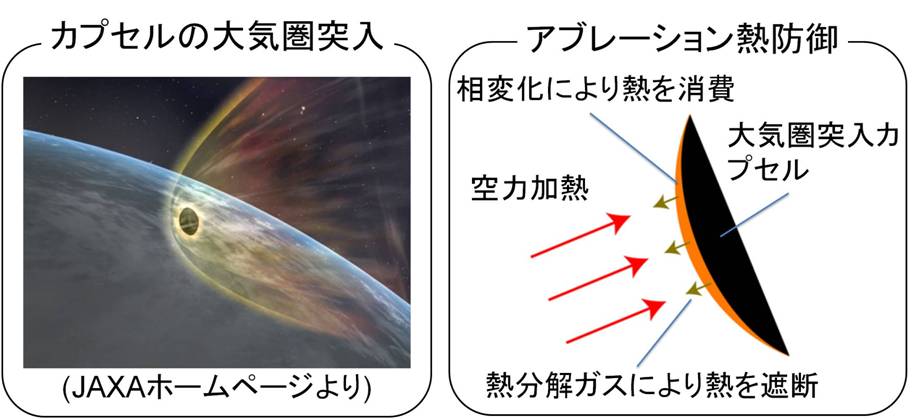
宇宙機は惑星の大気圏に突入する際に,その速度の大きさゆえ激しい加熱を受けます.小惑星探査機「はやぶさ」では大気圏再突入時の速度は秒速13km,表面温度は3000℃にも達したといわれています.このような厳しい環境から宇宙機を守るためにアブレータと呼ばれる炭素などの繊維に樹脂を含浸させた断熱複合材料が使用されてきました.
今後の展望
アーク加熱風洞での試験
アブレータは加熱によって,樹脂の熱分解や炭素繊維の昇華反応など物質の相変化を起こすことにより熱を消費します.また,熱分解により気体となった樹脂が吹き出すことで熱を遮断する効果もあります.このようにアブレータは相変化により自らを損耗させながら宇宙機を熱から守るので,必要な厚みを事前に見積もる必要があります.
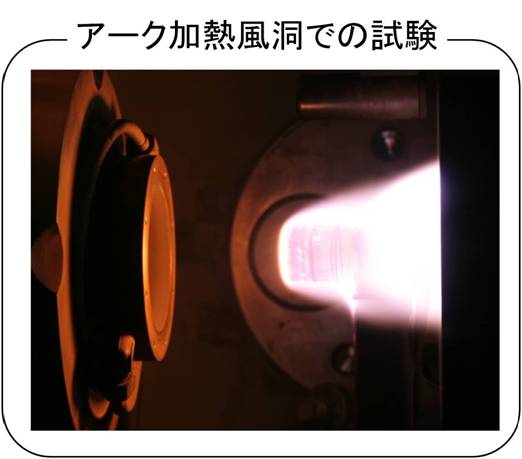
今後日本で計画される宇宙ミッションでは,これまでより軽いアブレータの適用が必要とされています.新しいアブレータの熱防御性能を評価するため,アーク加熱風洞と呼ばれる大気圏突入時の加熱環境を模擬できる装置を用いて加熱し,損耗量や表面と内部の温度変化履歴などを計測し,どれぐらいの厚みが必要かを,事前に正確に予測できる数学モデルの構築を行っています.[:en]
Atmoshperic Entry
About
During re-entry, the ablator which protects spacecraft from aerodynamics recedes by heat. Although, it is necessary to estimate appropriate thickness of ablator in advance, an actual heat condition in pre-flight experiment cannot be accurately estimated with current technology. This brings a problem that ablator has been increasing its weights, due to the overestimated thickness. In order to improve this problem, our lab researches to find useful methods for measuring its recession in the actual flights and to reduce ablator weights to lower the cost of flights.
Thermal protection by ablator
Entry and thermal protection
During entry, a spacecraft is extremely heated as it enters with super- or hyper-sonic speeds. The asteroid probe called “Hayabusa” returned to the earth at a speed of 13km/s with a high surface temperature (3000degree Celsius).In order to protect a spacecraft from this harsh environment, the thermal protection material made of carbon fibers impregnated with a resin is used.
Future Works
Experiment at Arc-heated wind tunnels
High temperature leads to a phase transformation such as thermo-decomposition of resin and sublimation of carbon fiber in the ablator. Afterward, a part of the internal resin becomes gaseous and it moves away through pores into surroundings. Finally, it protects itself from heating. In this way, this phenomenon prevents high temperatures from melting spacecrafts. Therefore, an appropriate thickness of the ablator must be estimated before flights.
For the future missions planned in Japan, a lighter ablator will be needed. In order to evaluate the thermal protection of a new ablator, the Arc-heated wind tunnel should be used. This can create re-entry heat condition from space to earth’s atmosphere. In addition, this can evaluate records of thermal between internal/external surfaces and a level of ablator’s recession. We built computational model which can measure an appropriate level of ablators’ thickness in advance.