




MPD Thruster
About
ロケットの燃費は,燃料をいかに高速で排気するかが問題となります.
深宇宙探査や将来の宇宙輸送ミッションには,化学燃料の燃焼によるエネルギーだけでは,達成できないほどの高い排気速度が要求されます.これらを実現するためには,電気的に燃料にエネルギーを加えることのできる”電気推進”の利用が不可欠となります.
本研究室では,大電力によって高効率・高排気速度を達成する電気推進機の開発を目指しています.
電気推進の利点
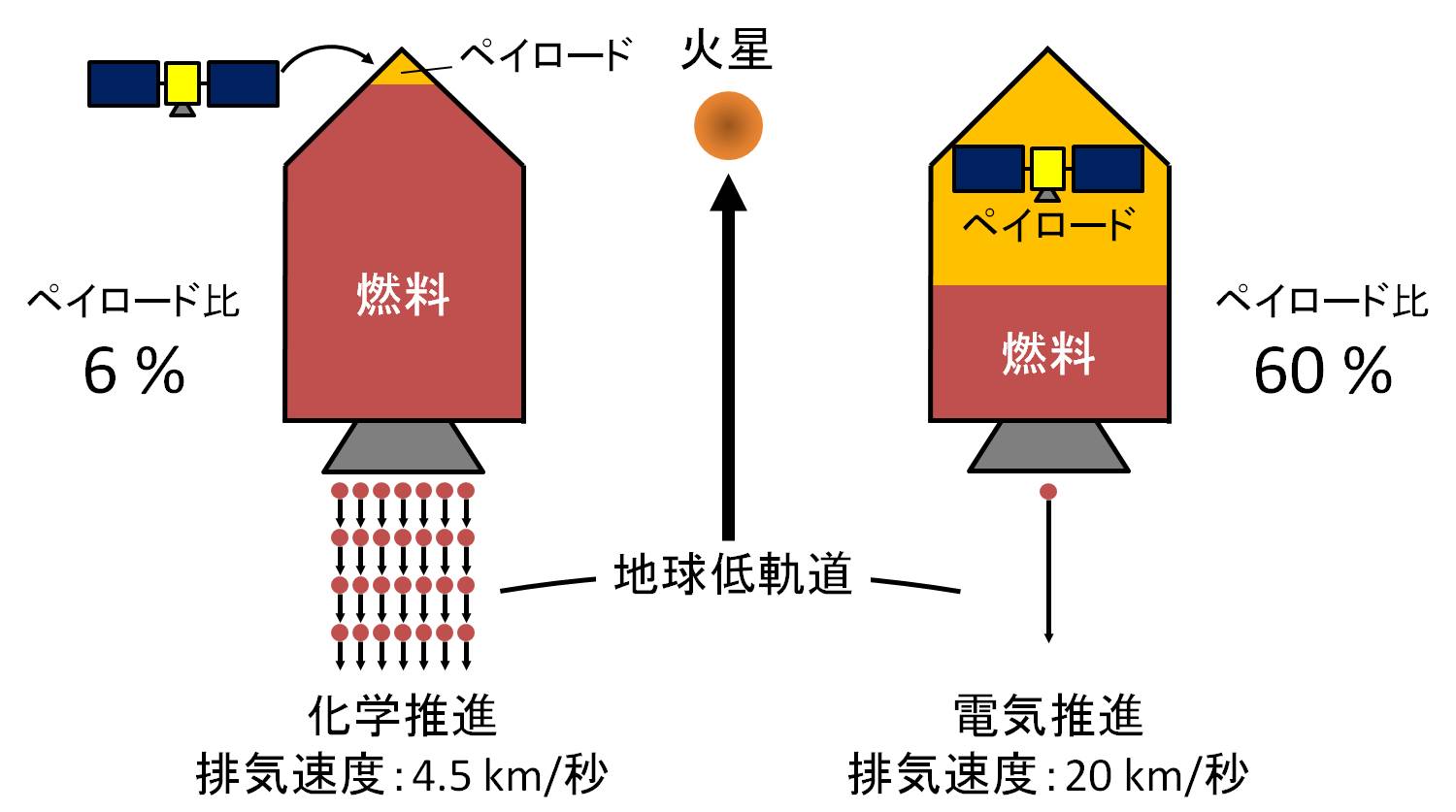
図1 化学推進と電気推進
電気推進は,その排気速度の大きさから,大きなΔVが要求されるミッションに用いられます.排気速度が大きいほど,少ない燃料で目標とするΔVを達成することができます.燃料を節約できる分,ロケットに搭載できる荷物(ペイロード)の割合を増やすことができます.(図1)ロケットエンジンの役割は,燃料噴射によってロケット本体を加速させ,目標とする速度に到達させることです.どれだけの速度増分ΔVが必要となるかは,ミッションによって異なります.
また,非常に大きなΔVが必要な深宇宙ミッションの場合,化学推進では到達できないものもあります.2010年に小惑星イトカワより帰還した小惑星探査機「はやぶさ」にも,電気推進機の一種であるイオンスラスターが搭載されました.
MPDスラスターの有用性
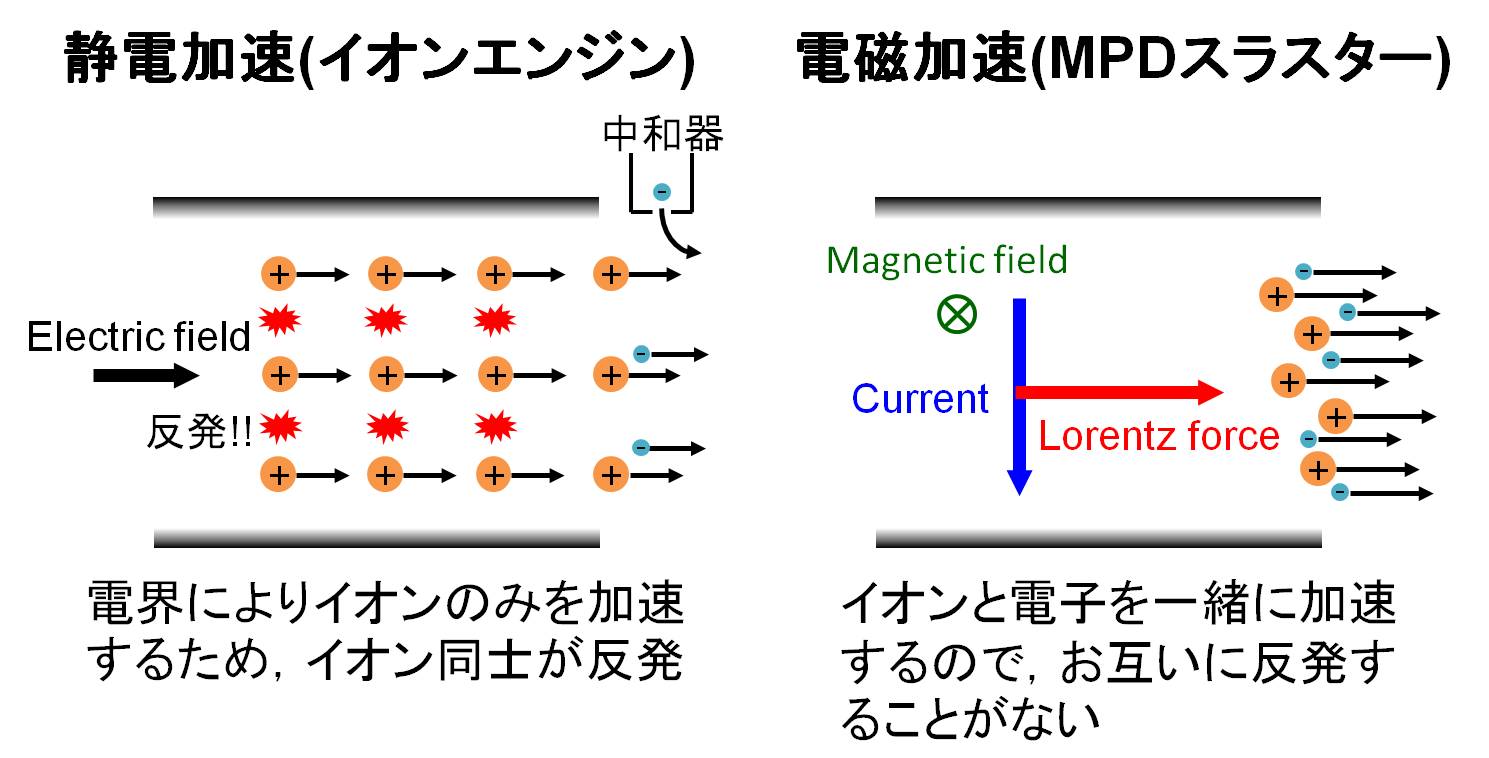
図2 イオンエンジンとMPDスラスターの違い
電気推進機では,推進剤(燃料)に電熱的にエネルギーを加えたり,プラズマ化(電離)してイオンと電子に分離した推進剤を,電場や磁場によって加速排気することができます.イオンスラスターは電場によるクーロン力でイオンのみを加速するため,あるところでイオン同士が反発しあい,推力密度を上げることができないという欠点があります.
一方,本研究室で取り扱っているMPDスラスターは,電流と磁場によるローレンツ力でイオンと電子を一緒に加速するため,推進剤粒子がお互いに反発することなく推力密度を上げることができます.(図2)また,他の電気推進機と比較して,
・構造がシンプルである
・推進剤の種類が豊富である
・大電力投入により推力の向上が見込まれる
といった理由から,将来の宇宙ミッションに適用可能な推進機の有力候補と考えられています.
これまでの成果
|
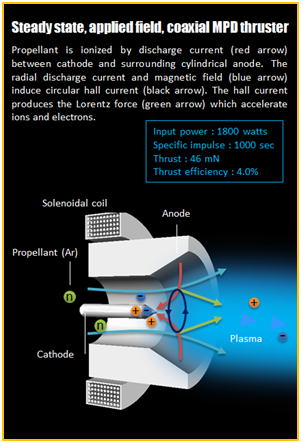
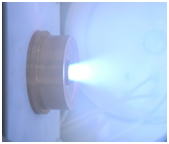
同軸MPDスラスター 定常作動型同軸MPDスラスタを開発し,推進剤流量および外部磁場,放電電流を変化させた場合の作動特性を取得しました.その結果.低流量・強磁場において推進効率の改善が見られました.しかしながら,同軸型はカソードの損耗が激しく動作特性そのものに影響することも分かりました. |
矩形形状MPDスラスター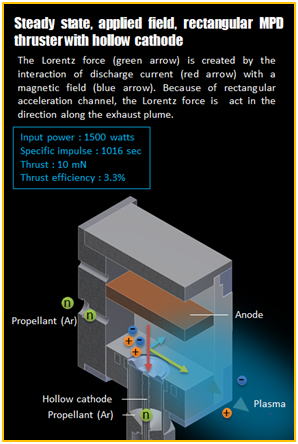 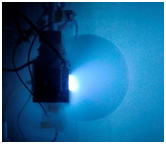 電極劣化による作動特性への影響を抑えるため,陰極にはホローカソードを使用したスラスタの開発を行いました.ホローカソードとは,イオンの衝突による損耗が少ないとされており,スラスタの長寿命化が期待されています.また,プラズマ生成・加速部分を矩形形状とすることでローレンツ力ベクトルを直接排気方向に向けることができ,同軸型に見られる推力の半径方向成分を抑えることを狙いました.現在,推力効率の分析を行い,より高効率・高比推力を有するスラスタに向けて改善を行っています. |
Rotate Magnetic Field スラスター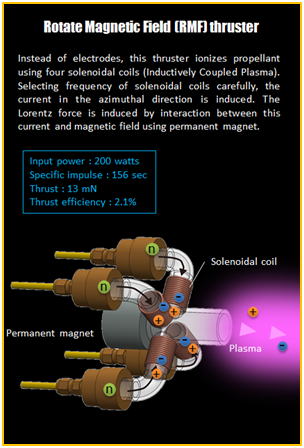 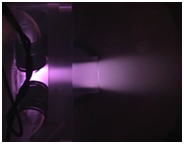 |
電極損耗の影響を抑える方法として,電極の存在しない無電極スラスタを開発しました.放電電流によってプラズマを生成するのではなく,コイル電流を利用した誘導加熱によって行います.また,コイル電流の周波数および位相差を適切な値に設定することで周方向の電流を発生させ,外部磁場との干渉によって生じるローレンツ力によってプラズマを加速・排気します.
Laser Propulsion
About
レーザー推進は、固体推進剤に対し遠方からレーザーを照射することで推力を発生させる、次世代宇宙機の推進法です。
本研究室ではこれまで、高速度カメラを用いた推力発生原理の解明や、独自の打ち上げ方法の構築・デモンストレーションを行ってきました。
現在は推力および推力効率改善を志向しており、レーザーの照射方法や推進剤の内部構造に着目した研究を行っています。
レーザー推進
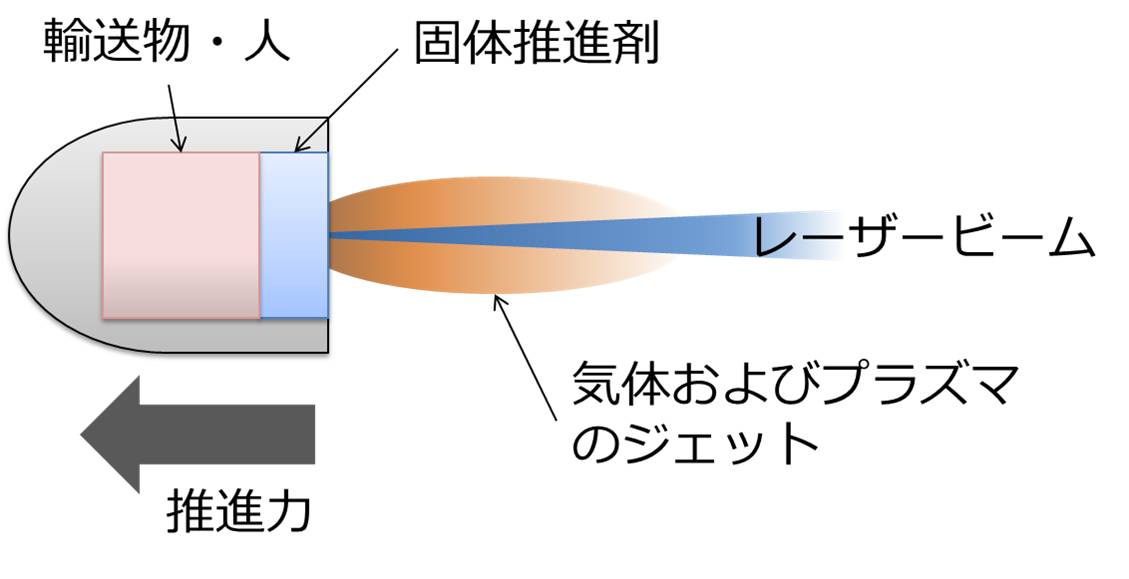
図1 レーザー推進原理
レーザー推進とは,ロケット本体に設置した固体推進剤に対し,レーザーを照射することで気化およびプラズマ化させ,その膨張の反力を利用した推進法です(図1).エネルギーの一部をレーザーによって外部から供給することで,従来の推進法に比べて搭載推進剤を大幅に低減できる可能性があります.そのため,推進剤や構造の重量を低減させたり,より多くの人や物を一度に輸送できるようになります.また,遠隔からエネルギーを供給できる利点を生かし,スペースデブリの除去や人工衛星の姿勢制御などへの応用も期待されます.
どういう仕組みで推力が生じているか?
レーザー照射によって固体燃料が気化・プラズマ化して吹き出す現象をレーザーアブレーションと言います.この現象を高速度カメラを用いて可視化を行い,運動量発生メカニズムの解明を行いました(図2).その結果,レーザー光吸収直後にアブレーションが発生し,その膨張によって力積が生じるという推力発生のメカニズムを実験にて証明することができました.ほかにも,大気圧中ではプラズマシールドの影響により,レーザー効率の低下が起きていることなど多くのことが分かってきています.
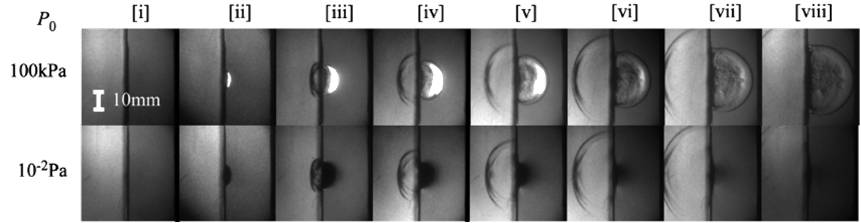
図2 シュリーレン画像(TEO CO2レーザー,ポリアセタール,撮影速度1000kfps)
燃料をまったく搭載せずに打ち上げられないか?
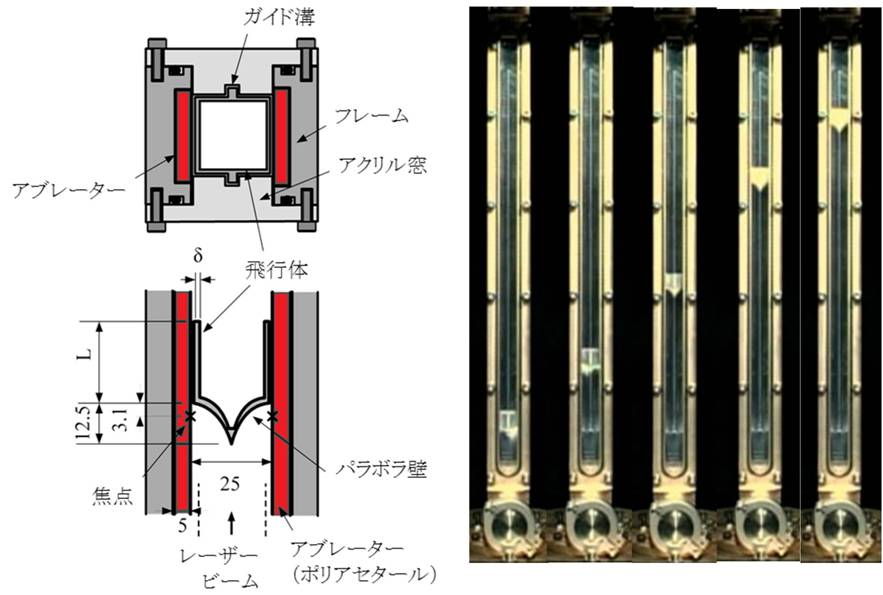
与えられたエネルギーからより推力を得られないか?
レーザー推進におけるレーザーの投入方法と得られる推力の関係は未だ分かっていません.そのため現在はさまざまなパルスの条件でレーザーを照射し,得られる推力を調査しています(図4).これまでに,パルスレーザーの繰返し照射にて連続して発生する力積を精度よく測定するために,ねじれ振り子式力積測定装置を独自に開発しました.この仕組みは,振り子の一端に設置した固体燃料に対しレーザーを照射し,アブレーションにより生じた振り子の変位を計測するというものです.振り子の四半周期を超えない限り,その間に生じたトータルの力積を測定することができます.
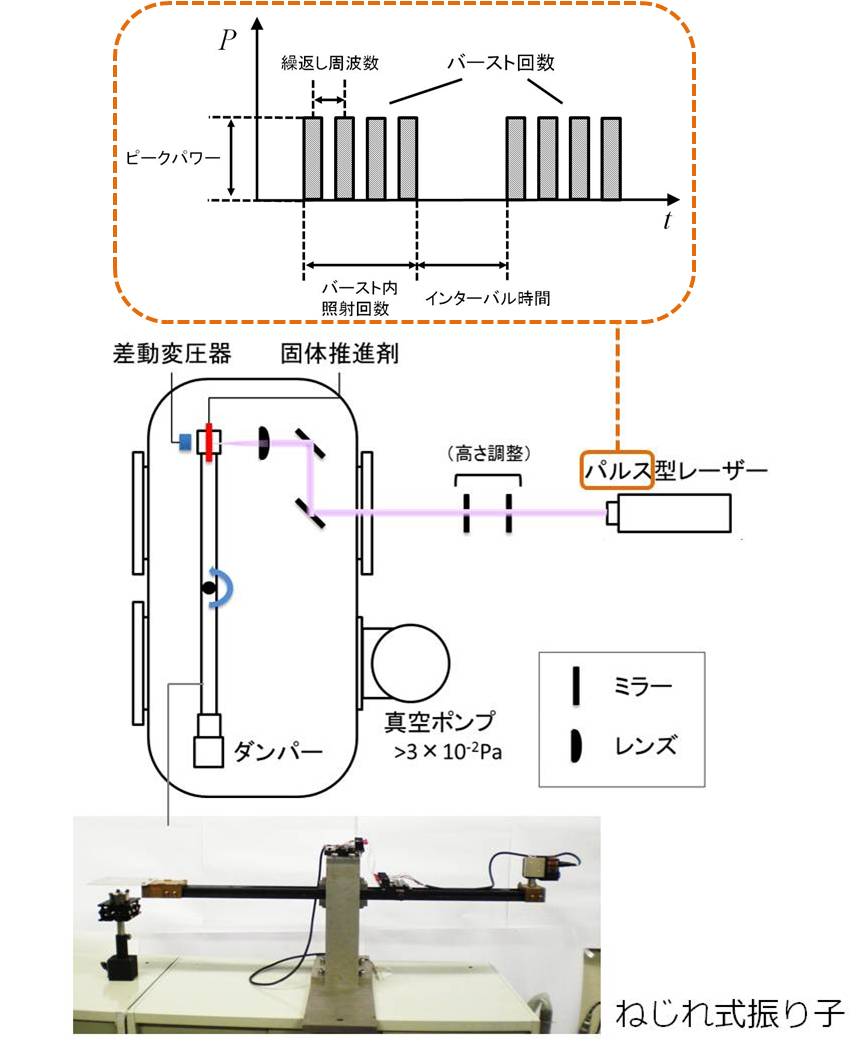
図4 レーザー投入方法と実験装置
Helicon Electrostatic Thruster
About
将来の有人火星探査,深宇宙探査において電気推進が注目されており,大推力,高比推力,高効率のスラスタが求められています.本研究では大電力推進機としてヘリコンプラズマを用いたスラスタに注目し,研究を進めています.
へリコンプラズマ
へリコンプラズマとは,軸方向磁場とある特定の周波数の高周波放電により作られるプラズマで,電子サイクロトロン放電法(ECR),誘導結合性プラズマ(ICP)のような他の高周波を用いたプラズマ生成法と比較して高密度なプラズマの生成が可能で,大推力電気推進機のプラズマ源として有力視されています.
| Plasma source | Frequency range | Plasma density [m³] |
| ECR | GHz | 1017 ~ 1019 |
| ICP | MHz (RF) |
~ 1019 |
| Helicon | 1019 ~ |
表1.高周波放電方式の他のプラズマ生成法との比較
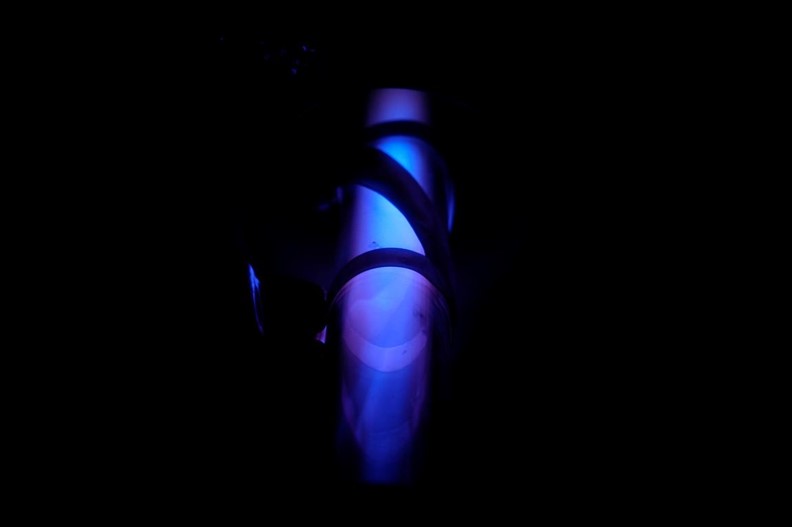
図1.へリコンプラズマ生成の様子(アルゴンガス)
Helicon Electrostatic Thruster (HEST)
先ほど紹介したヘリコンプラズマを図2のような形状の加速機を用いて放出するのが,名古屋大学で提唱する新しい加速方式の電気推進機であるHelicon Electrostatic Thruster(HEST)です.この方式では,カスプ磁場と呼ばれる磁場を使って陰極,陽極間の電界を保持し,その電界によってイオンの加速を行っています.そのプルーム中のイオンエネルギーを計測したところ,RF電力1500W,加速電圧300Vの条件において280eVのイオンエネルギーの生成を確認しました.このイオンエネルギーは加速電圧の93%に相当し,静電加速の有効性が確認されました.現在は加速メカニズムの解明,スラスタの最適化を行うことで,推進機の性能向上を目指しています.
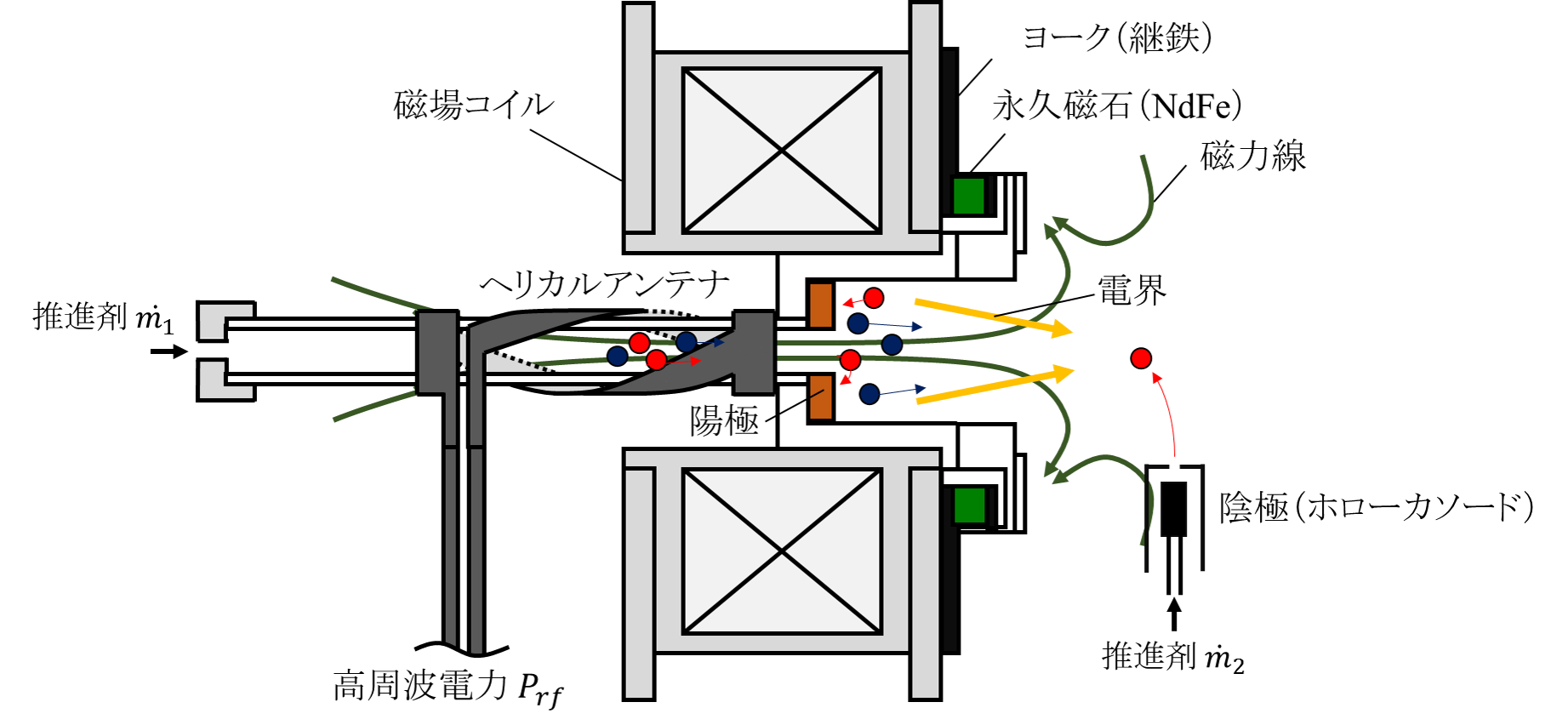
図2.HEST概念図
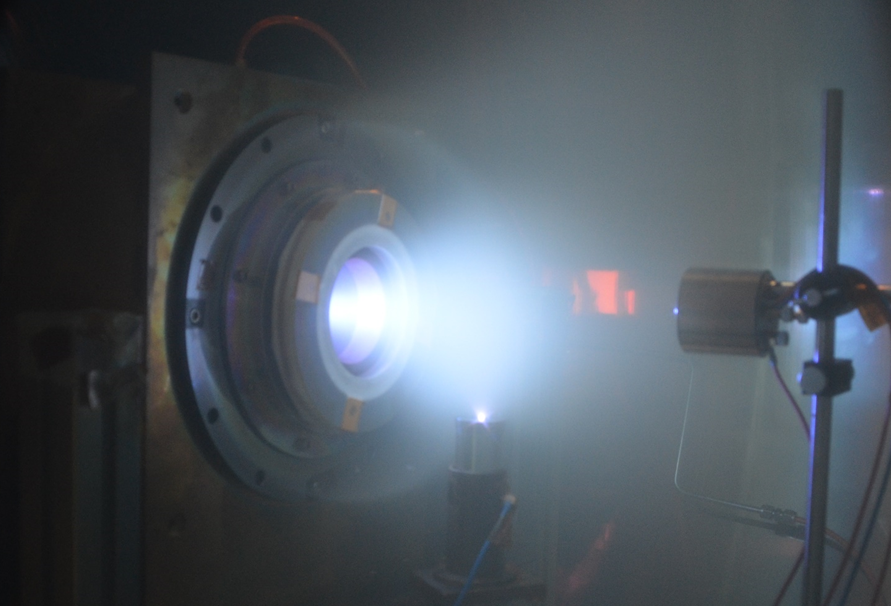
図3. HEST作動の様子
関連論文
- S.Harada, T.Baba, A.Uchigashima, S.yokota, A.Iwakawa, A.Sasoh, T.Yamazaki, and H.Shimizu, Applied Physics Letters, Vol. 105, ArtID 194101, 2014.
- A. Uchigashima, T. Baba, D. Ichihara, A. Iwakawa, A. Sasoh, T. Yamazaki, S. Harada, M. Sasahara, T. Iwasaki, IEEE Transactions on Plasma Science, Vol. PP(99), pp. 1-8, 2016.
Electrostatic Thruster (DM-EST)
About
先ほど紹介したHESTから派生した静電加速型の推進機です.DM-ESTとはDiverging magnetic field electrostatic thrusterの頭文字をとったものです.HESTと同じ発散磁場を用いており、下流の磁気フリー領域にカソードを配置することにより,磁力線を等電位面と仮定すると陽極近傍で半径方向内向き電界が作られます.この電界を利用することで陽極近傍で推進剤を電離させ,下流に向かって加速するという構造であり,HESTのプラズマ源+加速器という構造とは異なります.ホールスラスタに比べて単純な磁気回路により軽量化が可能であり,推進剤にキセノンに比べて安価なアルゴンを用いることでコスト面でのメリットを提供できると考えています.
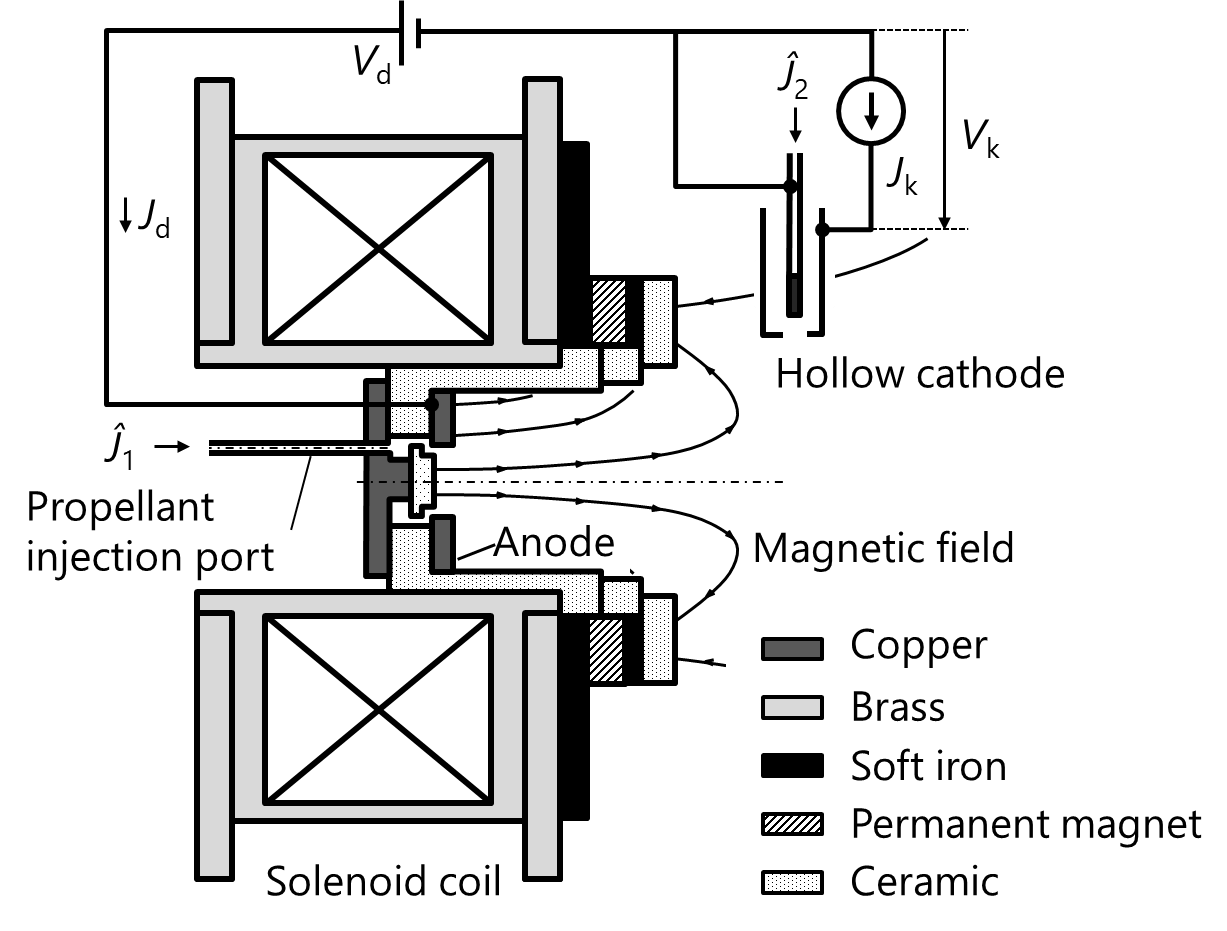
図4.DM-EST概念図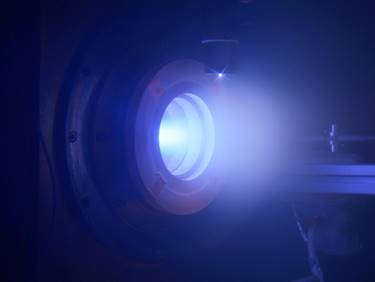
図5.DM-EST作動の様子
関連論文
- D. Ichihara, A. Uchigashima, A. Iwakawa, A. Sasoh, “Electrostatic ion acceleration across a diverging magnetic field”, AIP Applied Physics Letters 2016, Vol.109, Number 5
- Daisuke Ichihara, Akira Iwakawa, and Akihiro Sasoh. “Effects of magnetic field profile near anode on ion acceleration characteristics of a diverging magnetic field electrostatic thruster”, Journal of Applied Physics 122, 043302 (2017)
Electrostatic Thruster (CC-EST)
About
DM-ESTで陽極中心がカソード電位になることを利用し,推進剤を効率的に電離・加速するための試みを行いましたが,ここで中心にカソードを配置しても同じ効果が得られるのではないかと考えて考案されたものがつぎに紹介するCC-ESTになります.CC-ESTの「CC」はCenter Cathodeを意味します.この推進機においては電磁加速と静電加速の両方の特性を併せ持つことが実験的に確認されています.本研究グループのMPDスラスタではこれまでに実現できなかった程の高い電磁加速特性が得られており,推進機の性能改善やプラズマの物理現象の解明のため研究が進められています.
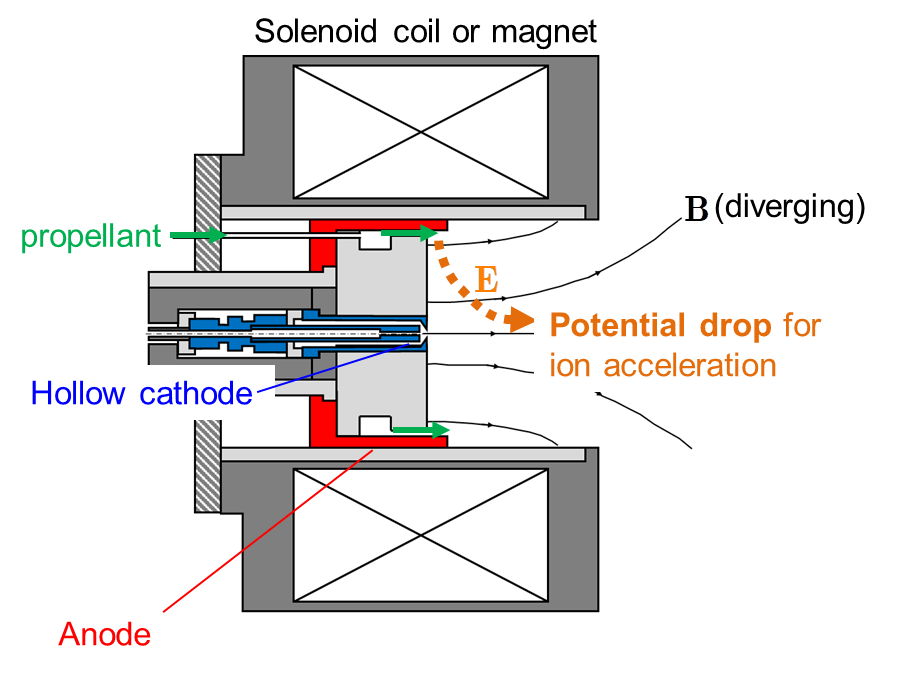
図6.CC-EST概念図
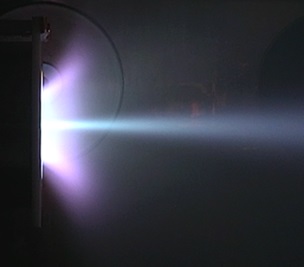
図5.CC-EST作動の様子
関連論文
- Akihiro Sasoh, Keisuke Mizutani, and Akira Iwakawa. “Electrostatic/magnetic ion acceleration through a slowly diverging magnetic nozzle between a ring anode and an on-axis hollow cathode”, AIP Advances(2017)
MPD Thruster
About
Propellant consumption rate of rocket is determined by its exhaust velocity.
Deep space explorations or future space transport missions require the high exhaust velocity, and it can not be achieved by chemical fuel combustion energy. For these missions, it is necessary to use “Electric Propulsion” which can use electric energy.
Our laboratory intend to develop the electric propulsion technology with high efficiency and high exhaust velocity using high power.
The Advantage of Electric Propulsion
Fig.1 Chemical propulsion and Electric Propulsion
The main purpose of rocket engine is to accelerate the rocket by propellant injection and achieve the intended velocity. The requirement of velocity increment DV depends on the missions.
Electric propulsion enables high exhaust velocity so that it is use for missions required high DV. These engines are able to get high DV with small propellant consumption. In other words, the rate of burden (payload) is increased. (Fig. 1)
Furthermore, in the missions required extremely high DV such as deep space exploration, it is impossible to get to the destination by chemical propulsion. Ion thruster used for asteroid probe “Hayabusa” returned from Itokawa asteroid in 2010, is one of the electric propulsion systems.
Usefulness of MPD Thruster
Fig.2 Difference of Ion thruster and MPD thruster
In the electric propulsion systems, the propellant is heated electro thermally, or ionized and accelerated by electric field or magnetic field. Ion thruster can accelerate only ions by Coulomb force in electrostatic field, but it has a limit of current caused by the mutual repulsion of ions.
Therefore, it can’t increase its thrust density. On the other hand, MPD thruster can accelerate both ions and electrons by Lorentz force in the electromagnetic field, so that it can get large thrust density without repulsion. And more, MPD thruster has features compared to other electric propulsion,
- It has simple configuration
- Various propellant gases can be used
- Improvement of thrust is expected when it is applied high-power
For these reasons, MPD thruster is one of the promising candidates for future high-power electric propulsion systems.
Current outcome
|
Coaxial MPD Thruster We have developed a steady-state, co-axial MPD thruster. Varying propellant mass flow rate, applied magnetic field and discharge current, thruster performance test were conducted. As a result, the thrust efficiency increased under row mass flow rate and high magnetic field. We also find that using co-axial geometry, wear on the cathode is very severe and it influences the thruster operation characteristics. |
Rectangular MPD Thruster To prevent cathode erosion, we have developed a MPD thruster using hollow cathode which is durable against ion bombard. Using this cathode, prolonging the thruster life time is expected. Furthermore, we employed rectangular acceleration channel to direct the Lorentz force to the exhaust. To develop a thruster with high thrust efficiency and specific impulse, we are currently working on analyzing thrust efficiency and improving the thruster. |
Rectangular MPD Thruster
One of our approaches for the problem of erosion of electrode, we developed electrodeless thruster. This thruster has no electrode exposed to the plasma. It can ionize the propellant by inductive heating using high frequency solenoidal coil current. We carefully tune the RF current phase to generate rotating magnetic and make azimuthal current. The interaction between this current and external magnetic field generate Lorentz force and accelerate the propellant. |
Laser Propulsion
About
Laser ablation propulsion is a next generation spacecraft propulsion method. Thrust is generated by beaming laser to propellant from a distant position.
Our study had investigated thrust generation law by using a high speed camera and had demonstrated an original launch method.
Currently, the focus is on impulse characteristics of repetition pulse irradiation as repetitive irradiation is expected to be needed in practical use.
Laser Propulsion
Fig.1 Principle of Laser Propulsion
Laser ablation is a phenomenon that a solid material is changed to gas or plasma by laser irradiation. Laser ablation propulsion is a next generation propulsion method using the ablation jet as thrust (Fig. 1). Since energy is partly supplied by laser beaming from a distant position, there is a possibility of reducing loaded propellant. Because of these merits it has, laser propulsion is expected to be applied to space debris re-orbiting and attitude control of satellite.
Theory of thrust generation
Laser ablation is a phenomenon that a solid material is changed to gas or plasma by laser irradiation. Momentum generation theory has been investigated by nanosecond scale visualization using a high speed camera (fig. 2). As a result, thrust generation theory has been verified. This is a theory that ablation is generated just after absorption of laser light and successive impulse is generated by expansion. In addition, a lot of phenomenons have been unveiled. For example, laser energy efficiency is decreased in atmosphere by plasma shielding.
Fig.2 Schlieren Image(TEO CO2 Laser,polyacetal,1000kfps)
How to launch without mounted fuel
How to get large thrust from limited energy source
The relation between laser irradiation method and impulse has yet to be clear. Therefore, laser is irradiated in various pulse conditions and impulse generated in these experiments are investigated(fig. 4). Heretofore, original impulse balance was developed in order to take accurate measurement of impulse generated by repeated irradiation of pulsed laser. This impulse balance is displaced by ablation when laser beam is irradiated to the target installed on the edge of the impulse balance. As long as impulse balance would not surpass quarter period, total impulse is able to be measured.
Fig.4 Experimental Setup
Helicon Electrostatic Thruster
About
Electric propulsion is the propulsion method that is expected for in future manned Mars exploration, farther space exploration, and so on. To use that way, the electric propulsion is needed to become a greater thrust, higher specific impulse, and higher efficiency thruster. In our study, We pay attention to a thruster using the helicon plasma as a large power thruster and push forward a study.
Helicon Plasma
Helicon plasma is the plasma that is made by a magnetic field and a high frequency electric discharge, and higher plasma density than like plasma made by high frequency discharge (e.g. Electron cyclotron resonant plasma(ECR), Inductively coupled plasma (ICP)). This plasma is regarded as the likely plasma source of high power electric propulsion.
| Plasma source | Frequency range | Plasma density [m³] |
| ECR | GHz | 1017 ~ 1019 |
| ICP | MHz (RF) |
~ 1019 |
| Helicon | 1019 ~ |
TABLE1. The Comparison of Other High Frequency Plasma
Fig1. Helicon Plasma (Argon)
Helicon Electrostatic Thruster (HEST)
It is Helicon Electrostatic Thruster(HEST) which is the new acceleration method for Electric thruster which is proposed in Nagoya University to emit the above-mentioned helicon plasma using the accelerator of the shape such as figure 2.
In this way, an electric field between the anode and the cathode is maintained by using the cusp magnetic field and accelerates the ion. After measuring the ion energy in the plume, I confirmed generation of the ion energy of 280eV in RF power 1,500W, acceleration voltage 300V. This was equivalent to 93% of acceleration voltage, and the effectiveness of the electrostatic acceleration was confirmed.
We are aiming at the performance enhancement of the thruster by elucidation of the acceleration mechanism and optimizing the thruster.
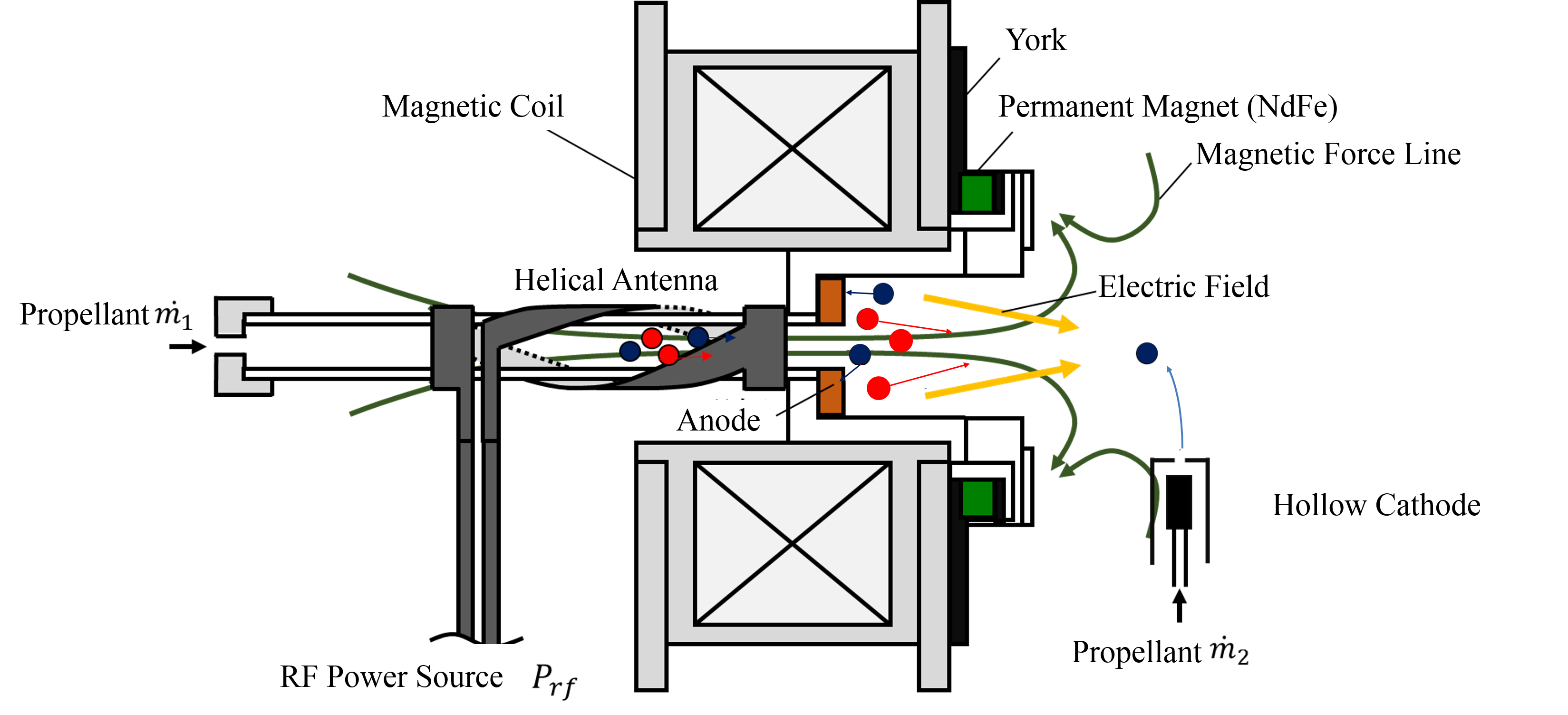
Fig2. HEST Overview
Fig3. HEST Operating Picture
Related Journal
- S.Harada, T.Baba, A.Uchigashima, S.yokota, A.Iwakawa, A.Sasoh, T.Yamazaki, and H.Shimizu, Applied Physics Letters, Vol. 105, ArtID 194101, 2014.
- A. Uchigashima, T. Baba, D. Ichihara, A. Iwakawa, A. Sasoh, T. Yamazaki, S. Harada, M. Sasahara, T. Iwasaki, IEEE Transactions on Plasma Science, Vol. PP(99), pp. 1-8,
Electrostatic Thruster (DM-EST)
About
It is an electrostatic thruster derived from HEST. DM-EST is an acronym for Diverging magnetic field electrostatic thruster. By using the same divergent magnetic field as HEST, by placing the cathode in the downstream magnetic free region, assuming that the magnetic force lines are equipotential surfaces, a radially inward electric field is created in the center of the anode. By utilizing this electric field, the propellant is ionized near the anode and accelerated toward the downstream. We believe that it is possible to reduce the weight by a simple magnetic circuit compared to the Hall thruster and that it can provide the merit in terms of cost by using inexpensive argon compared to xenon as the propellant.
Fig4.DM-EST Overview
Fig5.DM-EST Operating Picture
関連論文
- D. Ichihara, A. Uchigashima, A. Iwakawa, A. Sasoh, “Electrostatic ion acceleration across a diverging magnetic field”, AIP Applied Physics Letters 2016, Vol.109, Number 5
- Daisuke Ichihara, Akira Iwakawa, and Akihiro Sasoh. “Effects of magnetic field profile near anode on ion acceleration characteristics of a diverging magnetic field electrostatic thruster”, Journal of Applied Physics 122, 043302 (2017)
Electrostatic Thruster (CC-EST)
About
We tried to ionize and accelerate the propellant efficiently by making use of the fact that the anode center becomes the cathode potential in DM – EST, but the same effect can be obtained even if the cathode is arranged at the center of the anode. Then, CC – EST is invented. “CC” in CC-EST means Center Cathode. It has been experimentally confirmed that this thruster has both characteristics of electromagnetic acceleration and electrostatic acceleration. Our research is under way to improve the performance of this thruster and elucidation of physical phenomena of plasma.
Fig6.CC-EST Overview
Fig5.CC-EST Operating Picture
関連論文
- Akihiro Sasoh, Keisuke Mizutani, and Akira Iwakawa. “Electrostatic/magnetic ion acceleration through a slowly diverging magnetic nozzle between a ring anode and an on-axis hollow cathode”, AIP Advances(2017)