




衝撃波と各種流れ場の干渉
衝撃波が上流(移動する衝撃波であれば衝撃波前方)に存在する特異な流れと相互干渉すると、圧力場や流れ場の時空間的な特性が大きく変わります。例えば超音速飛行で生じる衝撃波の上空から地上への伝播を考えます。このとき衝撃波は伝播経路に存在する大気乱流の影響を受けその形状を大きく変化させ、背後の圧力場が局所的に変調することが知られています。この衝撃波による地上での爆発音(ソニックブーム)も局所的に強度が変わることが分かっており、正確な予測を困難にしています(Fig. 1)。また超音速空気吸い込み口や推進器内に定在する衝撃波は境界層や上流で生じた擾乱と干渉し、流れの不安定モードの誘発や効率低下を引き起こすとされています。
衝撃波による騒音低減手法の確立や超音速飛行における革新的な飛行性能向上を達成するには、基礎的な系において衝撃波が様々な流れと干渉するときに生じる現象を理解しておく必要があります。
衝撃波・宇宙推進研究グループでは対向衝撃波管 (Fig. 2) という対向する2つの衝撃波を形成できる研究室独自の装置を使用し、衝撃波と様々な流れの干渉に関する実験研究を行い、超音速飛行における様々な問題解決へ繋げるため 衝撃波の流れ場による変調の理解 と 衝撃波の効果的な低減・制御手法の確立 を目指しています。
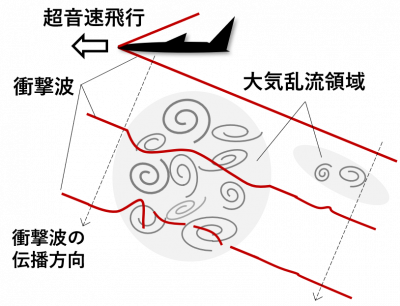
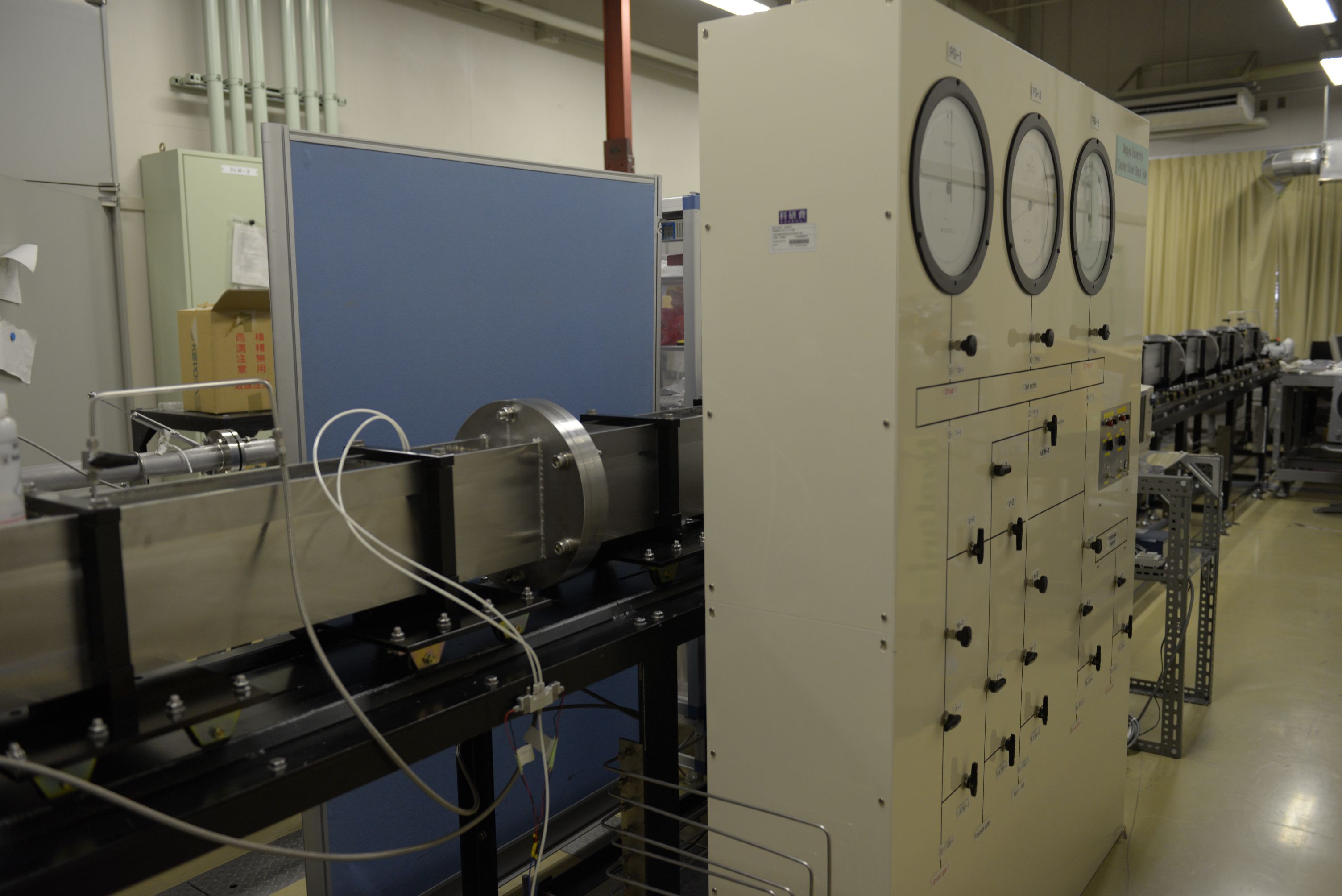
Fig. 2 対向衝撃波管
衝撃波−乱流干渉
衝撃波と乱流が干渉するとき、それぞれの物理的特性が大きく変わります。この現象は、超音速飛行による衝撃波が大気乱流により影響を受けることで起こるソニックブーム強度の変調や、爆発による衝撃波の遠方場での過剰圧特性などに関連します。この「衝撃波-乱流干渉」現象についてはこれまでに数値計算や実験で多くの研究が行われていますが、われわれの研究グループでは研究室独自に開発した対向衝撃波管を使用し、これまでに実現されてこなかった平面衝撃波と格子乱流のパラメトリック干渉実験に成功し衝撃波の大規模変形や波面消失に関してあらたな知見が得られています。
【動画】衝撃波(右向きに進行、衝撃波マッハ数1.03)と、強い乱流(左向きに進行、乱流マッハ数0.024)の干渉のシャドウグラフ可視化。この手法では密度の変化が明るさの変化として可視化されています。
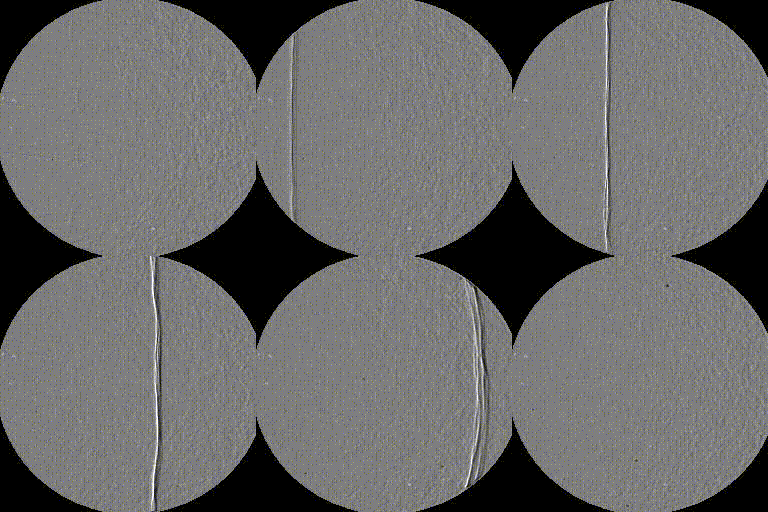 | 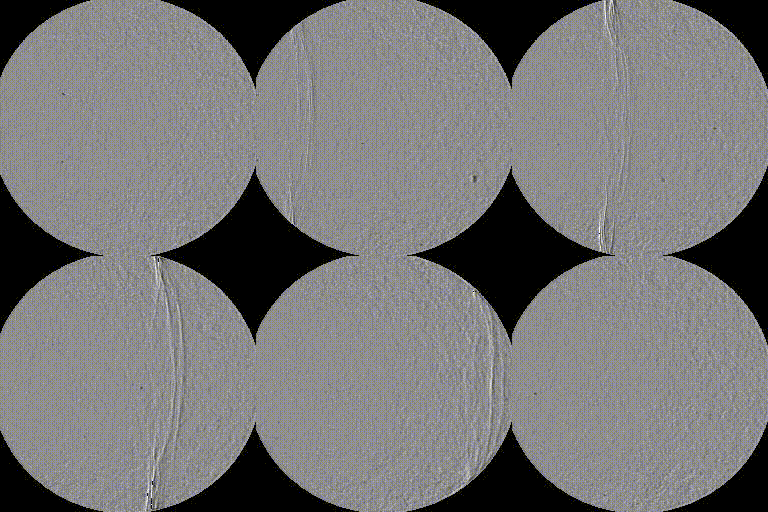 |
| 可視化窓中心部での干渉距離 65 mm | 1121 mm |
関連論文
- G. Fukushima, S. Ogawa, J. Wei, Y. Nakamura and A. Sasoh, ” Impacts of grid turbulence on the side projection of planar shock waves,” Shock Waves , 1-15(2021).
doi: 10.1007/s00193-021-01000-2 - G. Fukushima, J. Wei, S. Ogawa, J. Hagiwara, Y. Nakamura and A. Sasoh, “Losing the shock wave front profile due to interaction with turbulence,” Fluid Dyn Res 53(2), 025504 (2021).
doi: 10.1088/1873-7005/abeda4 - T. Tamba, G. Fukushima, M. Kayumi, A. Iwakawa, and A. Sasoh. “Experimental investigation of the interaction of a weak planar shock with grid turbulence in a counter-driver shock tube,” Phys. Rev. Fluids4, 073401 (2019).
doi: 10.1103/PhysRevFluids.4.073401
衝撃波−前方誘起流速干渉
衝撃波が前方に存在する衝撃波進行方向と同じ向きに誘起された流速場と干渉するとき、一次元の不連続問題であるリーマン問題から得られる解析解では干渉後の衝撃波は干渉前と比較し弱くなります。この原理を応用し、流速作用による衝撃波低減手法の開発を目指し実験を行っています。
関連発表
- 小川真吾,福嶋岳,Wei Jiaxi,萩原淳,中村友祐,佐宗章弘,「 前方流速誘起による衝撃波強度の低減 」 ,2020年度衝撃波シンポジウム ,2B4-4
衝撃波−対向ジェット干渉
上記の前方誘起流速の場合とは逆に衝撃波が対応するジェットと干渉するとき、対向する流速の作用により衝撃波の局所強度の増加とそれに伴う変形現象が見られます。流速場が衝撃波に及ぼす影響を基礎的に理解するため非定常ジェットと衝撃波の干渉実験を行っています。
関連発表
- Wei Jiaxi,福嶋岳,小川真吾,萩原淳,中村友祐,佐宗章弘,「対向噴流による衝撃波形態の変化に関する研究 」,2020年度衝撃波シンポジウム,2B4-3
Shock interaction
Shock waves are affected by atmospheric turbulence in their propagation paths, which can significantly change their shape and locally modulate the pressure field behind them (Fig. 1). It is known that the sonic boom caused by the modulated shock wave by atmospheric condition makes it difficult to predict accurately intensity of the sonic boom on the ground. Understanding the fundamental interactions between the shock wave and the flow field is also important for complex phenomena such as shock wave-boundary layer interaction (SWBLI), which affects performance of propulsion system in supersonic flight.
To improve performances of supersonic flight, we experimentally investigate fundamental interactions between shock wave and various flow field.
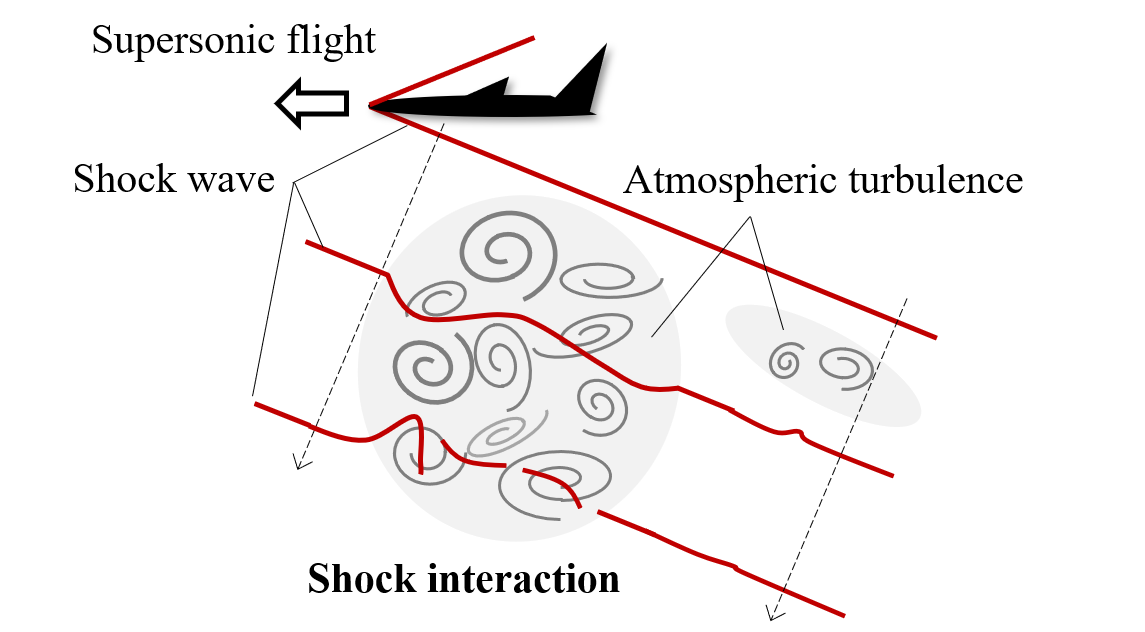
Fig. 1 Schematic of shock-atmospheric turbulence interaction in supersonic flight
Fig. 2 Counter-driver shock tube (CD-ST)
Shock-turbulence interaction
When a shock wave undergoing sudden compression passes through a turbulent flow (random flow), complex changes occur. For example, this phenomenon is closely related to the noise problem (sonic boom) caused by the shock wave generated in supersonic flight. To predict the strength of a sonic boom that changes due to atmospheric turbulence (atmospheric turbulence), it is necessary to understand the fluid physics and to quantify the effect of the shock wave and turbulence interaction. In our laboratory, we have developed a “counter-driver shock tube (CD-ST)” that can perform interactions between shock waves and various flows with, and are conducting the experiments of the interaction of shock wave with grid turbulence. The shock wave propagating through grid turbulence was visualized under changing the strength of the shock wave and the turbulence intensity. As a result, it was confirmed that the deformation of the shock wave progressed as the interaction length of the shock wave and turbulence increased. Among the experiments we have conducted, the interaction between the strongest turbulence (turbulence Mach number *1 Mt = 0.024) and shock wave (shock wave Mach number *2 Ms = 1.03) showed interesting phenomena. Although the shock wave was straight soon after the start of interaction (Interaction length: 65 mm), it became deformed and dispersed when the interaction length exceeded 1 m (Interaction length: 1121 mm). The “broken” phenomenon of shock waves due to turbulence interaction have reported in numerical studies. This study firstly observed the “broken” phenomenon of the shock wave in experiments. Details of the research are shown in the paper listed below.
The followings are shadowgraph visualization movies of the interaction between the shock wave (moving to the right, shock wave Mach number 1.03) and turbulence (moving to the left, turbulence Mach number 0.024). In this method, changes in density are visualized as changes in brightness.
Related publications
- G. Fukushima, S. Ogawa, J. Wei, Y. Nakamura and A. Sasoh, ” Impacts of grid turbulence on the side projection of planar shock waves,” Shock Waves , 1-15(2021).
doi: 10.1007/s00193-021-01000-2 - G. Fukushima, J. Wei, S. Ogawa, J. Hagiwara, Y. Nakamura and A. Sasoh, “Losing the shock wave front profile due to interaction with turbulence,” Fluid Dyn Res 53(2), 025504 (2021).
doi: 10.1088/1873-7005/abeda4 - T. Tamba, G. Fukushima, M. Kayumi, A. Iwakawa, and A. Sasoh. “Experimental investigation of the interaction of a weak planar shock with grid turbulence in a counter-driver shock tube,” Phys. Rev. Fluids4, 073401 (2019).
doi: 10.1103/PhysRevFluids.4.073401
Shock-forward induced flow interaction
(under construction)
Shock-counter jet interaction
(under construction)